Skip to content

Nebenkosten

On the App Store as: Nebenkostenabrechnung einfach (German)

A private landlord only needs the receipts at the end of the year, and by then half of them are missing. In my app you simply photograph them during the year and it reads amount and cost type on its own. From the property manager's statement it works out what the tenant pays, and the letter only goes out once every cent is allocated.

View on the App StoreApp website (German)Version 1.3.1, November 2026
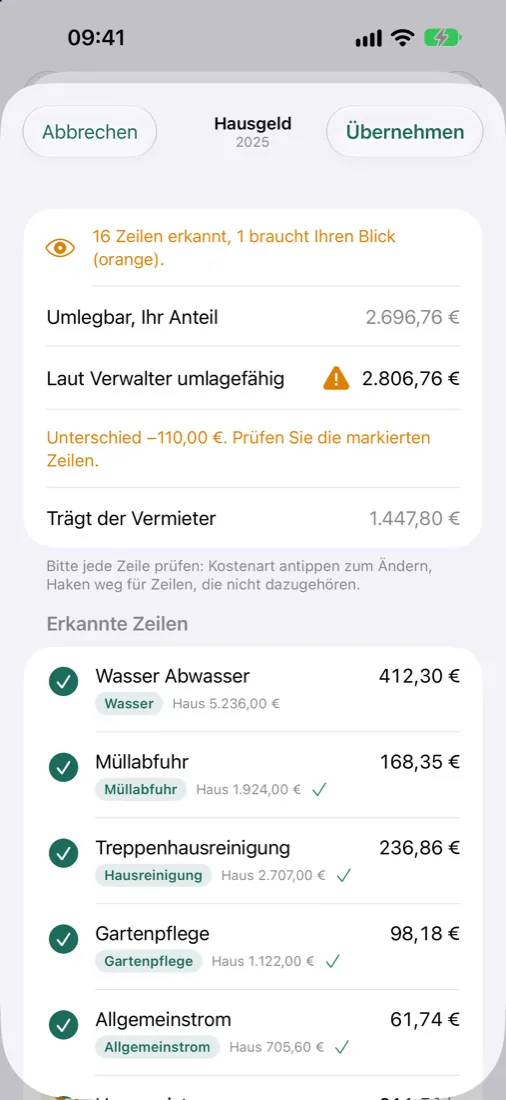
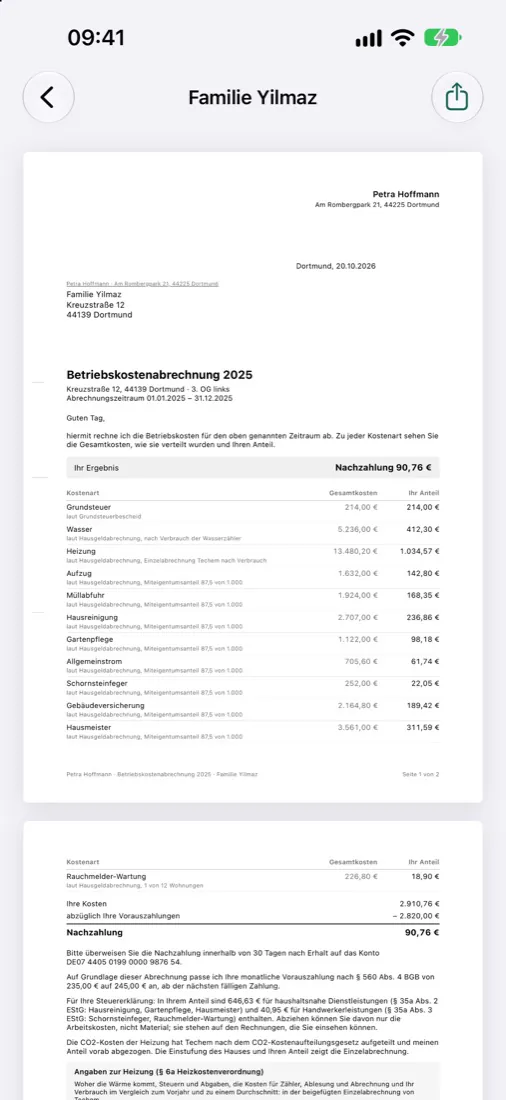
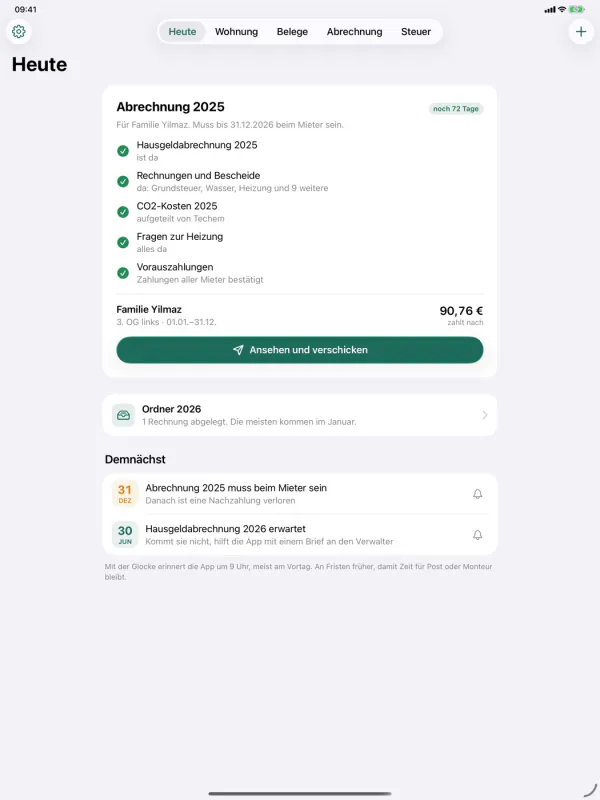
Nebenkosten on the iPad: the Today overview with the bill for 2025Nebenkosten on the iPhone: the property manager statement recalculated line by lineNebenkosten on the iPhone: the finished letter to the tenants

What it is about

The app is made for private landlords in Germany with one rented flat or a small house. Once a year they have to bill the running costs (Nebenkosten) to their tenant. Invoices, meter readings and the property manager's statement arrive throughout the year, everything is only needed at the end, and by then half of it is missing.

The app collects the year as it goes. At the end there is a letter to the tenant, checked and ready to send.

How it works

  • Collect: you photograph the whole stack in one go or pick photos and PDFs. The app reads amount, date and cost type on the device, files what is unambiguous and asks one short question for every doubt.
  • Understand the manager's statement: the app shows which items may be passed on to the tenant and which may not, and recalculates the totals.
  • Check: before the letter goes out, the app audits the bill itself. Every cent is allocated, every day belongs to a tenant or to the landlord.
  • Send: the letter comes as a PDF to print, mail or share.

What was hard

Reading without guessing

A wrongly read amount is worse than a missing one, because nobody notices it. Whatever the app cannot read with confidence it marks in orange and asks about. For the manager's statement it recalculates the totals and so notices when a line cannot be right.

The special cases are the normal case

Hardly any bill is simple. If a tenant moves out mid-year, everyone pays their own consumption when there is an interim reading, otherwise the app splits by days. If the number of occupants changes, it allocates by person-days. For the CO2 cost of heating it calculates the share the landlord has to bear. If an appeal against the property tax is pending, it recalculates after the decision and writes each tenant a short letter.

The data stays with the landlord

There is no account. Receipts are read on the device and stay there. For moving to a new device there is a backup as a single file.

Where the idea came from

The idea came out of my own analysis of App Store search: I measure what people search for and where the existing apps are weak. The first run started with 676 seed words, which became 5,574 search terms and 4,627 analysed result lists. Three ideas were left at the end. The running-cost bill was one of them.

Key facts

On the App Store since
October 2026
Runs on
iPhone and iPad
Built
solo
Tech
Swift, SwiftUI, SwiftData, Vision, PDFKit, StoreKit